Volume Two · Available now
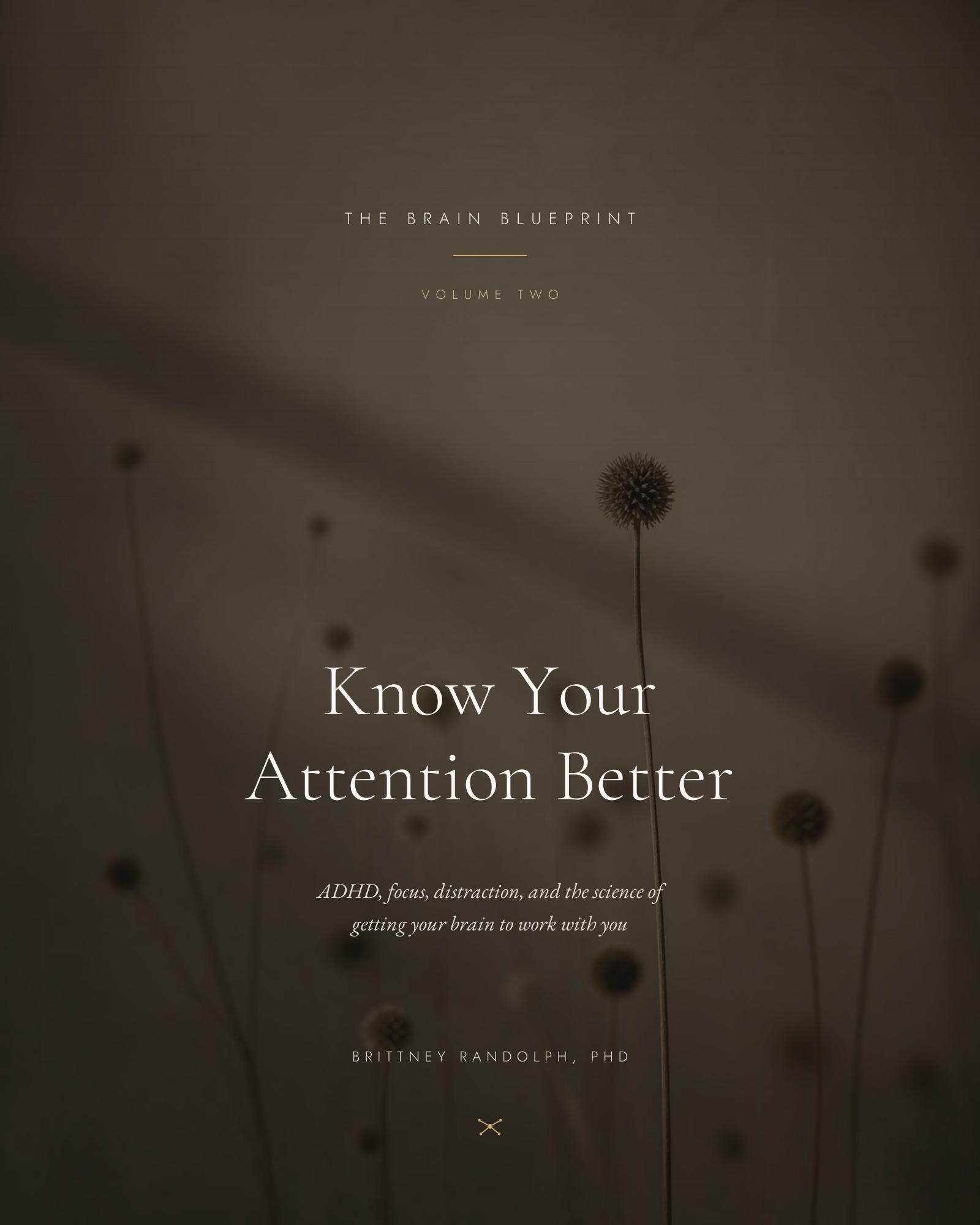
Know Your Attention Better
ADHD, focus, distraction, and getting your brain to work with you.
A workbook on attention: how it is built, what erodes it, and how to construct the conditions in which focus becomes ordinary rather than heroic. Written for anyone who has wondered why attention behaves the way it does — including brains with ADHD.
- Length
- 269 pages
- Lessons
- Structured chapters and exercises
- Completion
- Read at your own pace
- Format
- Digital PDF · print-ready
What you'll learn
- The difference between attention, vigilance, and interest.
- What ADHD actually changes about attention — and what it does not.
- Why interruption costs more than the minutes it takes.
- How to design an environment that holds attention for you.
Who it's for
- Adults with ADHD, diagnosed or wondering.
- Readers whose attention feels shorter than it used to be.
- Anyone who wants fewer, better hours rather than more of them.
Inside the pages
A few spreads from the workbook — essay, exercise, and figure — reproduced at reading scale.
Lesson 04
The cost of the small look away
Attention does not resume where it left off.
It reconstructs — and reconstruction is the expensive part.
Exercise 06
One week of interruptions
What interrupted you?
Who initiated it — you, or something else?
How long until you were fully back?
Figure 5.1
Depth over a working day
What's included
- 01269-page designed workbook, delivered as a high-resolution PDF
- 02Structured chapters with guided written exercises
- 03Printable attention audit and weekly planning sheets
- 04Lifetime access, including future revisions
Questions
Is this a course?
No. It is a designed workbook — a self-contained document you read, write in, and keep. There are no videos, no logins, and no schedule.
How is it delivered?
As a high-resolution PDF immediately after purchase. It is designed to be beautiful on screen and equally considered in print.
Is this a substitute for therapy or medical care?
It is not. The workbook is educational and may sit alongside clinical care, but it does not replace assessment or treatment.
Also in the series

From the clinical practice
The Brain Blueprint is written by Brittney Randolph, PhD, a clinical neuropsychologist. If reading raises questions about your own attention or memory, formal evaluation is available virtually.