Volume Six · Planned
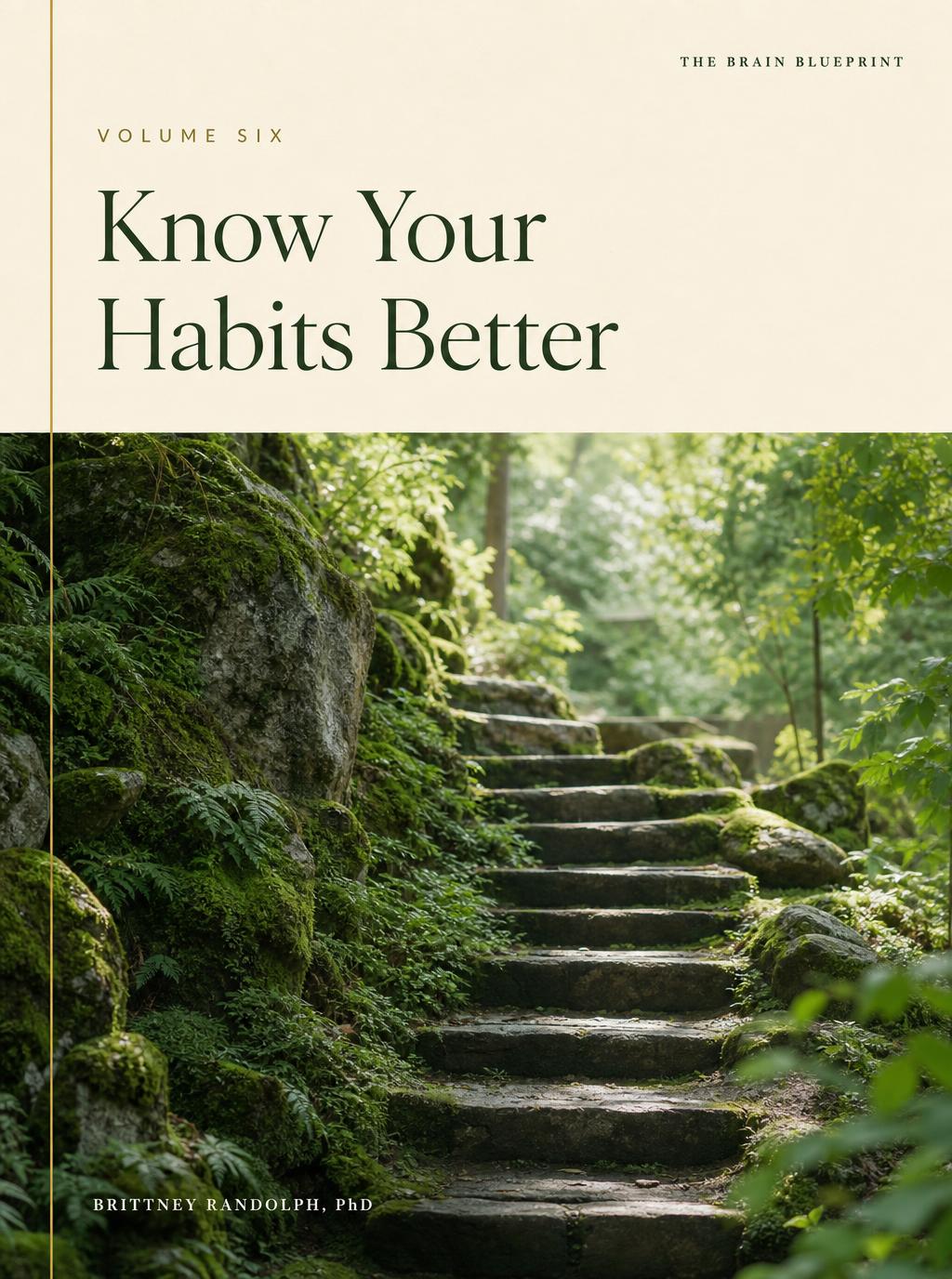
Know Your Habits Better
Understanding why your brain repeats what it repeats.
Discover how habits are formed, why behaviors become automatic, how the brain changes through repetition, and how lasting change happens through neuroscience rather than willpower alone.
- Length
- 72 pages
- Lessons
- 11 lessons
- Completion
- 4–6 hours, at your own pace
- Format
- Digital PDF · print-ready
What you'll learn
- What a habit is structurally, and where it lives in the brain.
- Why context does more work than discipline.
- How to shorten the distance between intention and repetition.
- A method for changing one routine without dismantling the rest.
Who it's for
- Readers who start well and stall in week three.
- Anyone rebuilding routines after a season of disruption.
- People who want structure rather than exhortation.
Inside the pages
A few spreads from the workbook — essay, exercise, and figure — reproduced at reading scale.
Lesson 03
Repetition is necessary, not sufficient
A habit forms where a cue is stable and the response is cheap.
Change either one and the automaticity you built quietly dissolves.
Exercise 05
Audit one routine
What reliably precedes the behaviour?
What friction sits between the cue and the action?
What could be removed rather than added?
Figure 2.3
The habit architecture
What's included
- 0172-page designed workbook, delivered as a high-resolution PDF
- 0211 structured lessons with guided written exercises
- 03Printable habit architecture and review sheets
- 04Lifetime access, including future revisions
Questions
When does it release?
It is in preparation. Join the list and you'll receive one short note the day it becomes available.
Is this a course?
No. It is a designed workbook — a self-contained document you read, write in, and keep. There are no videos, no logins, and no schedule.
How is it delivered?
As a high-resolution PDF immediately after purchase. It is designed to be beautiful on screen and equally considered in print.
Is this a substitute for therapy or medical care?
It is not. The workbook is educational and may sit alongside clinical care, but it does not replace assessment or treatment.
Volume Six
Know Your Habits Better
$79
Also in the series

From the clinical practice
The Brain Blueprint is written by Brittney Randolph, PhD, a clinical neuropsychologist. If reading raises questions about your own attention or memory, formal evaluation is available virtually.